


"Khibra"
She crouches like a panther mid-prowl—coiled energy wrapped in cotton and consciousness. The braids speak in technicolor dialects, each bead a chapter of heritage strung tight against her scalp. At her throat, the Eye of Horus pulses: ancient surveillance meeting modern gaze, watching how users experience her world.
"Khibra" isn't just expertise here—it's the wisdom encoded in posture, in the deliberate crease of fabric that reads UserExperience. She designs her own narrative architecture, one where the interface between self and lens becomes sacred ground. Every pixel tells you: mastery wears white tee-shirts and knows exactly where to look.
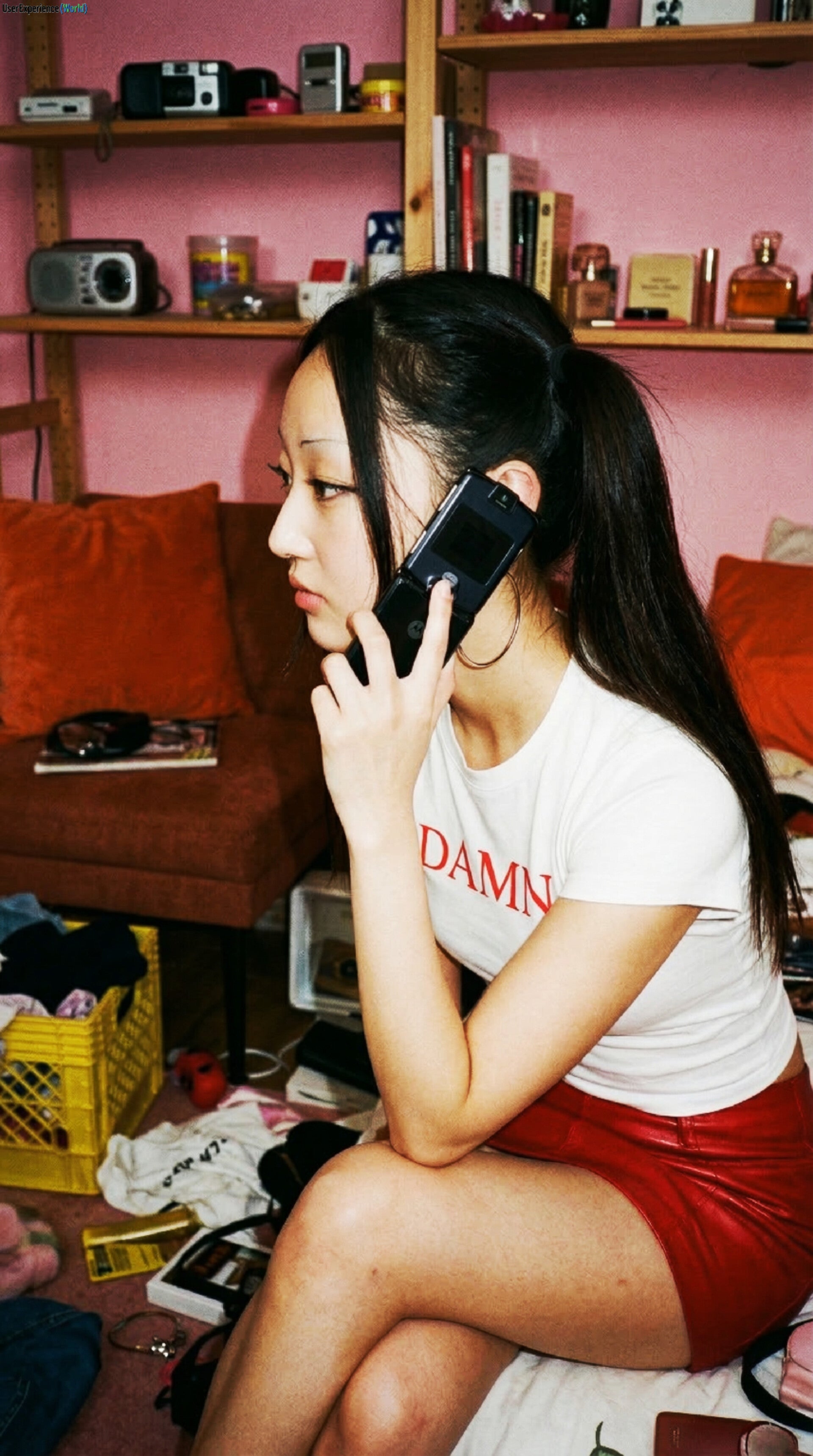
"A Moment on Hold"
She holds the flip phone like a sacrament, plastic warming against her cheek while the room holds its breath around her. Pink walls absorb the afternoon, casting everything in the sepia of nostalgia—analog cameras lined up like sentinels on wooden shelves, their lenses dormant but watchful. The radio sits silent, refusing to compete with the monotony of hold music buzzing through the receiver, that mechanical drone that measures absence in electric hums.
Her shirt blares DAMN in crimson letters, a protest or a prayer against the tyranny of waiting. The leather skirt catches light from somewhere unseen, vermillion pooling at her thighs as she perches amid the organized chaos of actual living: yellow crates spilling fabric, paperbacks splayed open at broken spines, amber bottles catching dust in gradients of gold and umber. Every object tells a story she’s not speaking right now, accumulating in strata around her stillness.
This is the architecture of anticipation—the suspended animation between sentences, where breath becomes currency and time stretches elastic. Her fingers press harder against the casing, knuckles pale with the effort of patience. Somewhere through the line, a voice will return, but here, in this cocoon of coral walls and vintage electronics, she exists in the liminal space of almost. The clutter becomes a fortress. Cassette tapes and film canisters witness her resolve, this modern tableau of connection deferred. She doesn’t shift her weight, doesn’t surrender the receiver to check the minutes elapsed. Instead, she becomes part of the room’s curated disarray—another artifact waiting to be activated, holding the line literally and otherwise, until the silence finally fractures and the moment releases her back into motion.
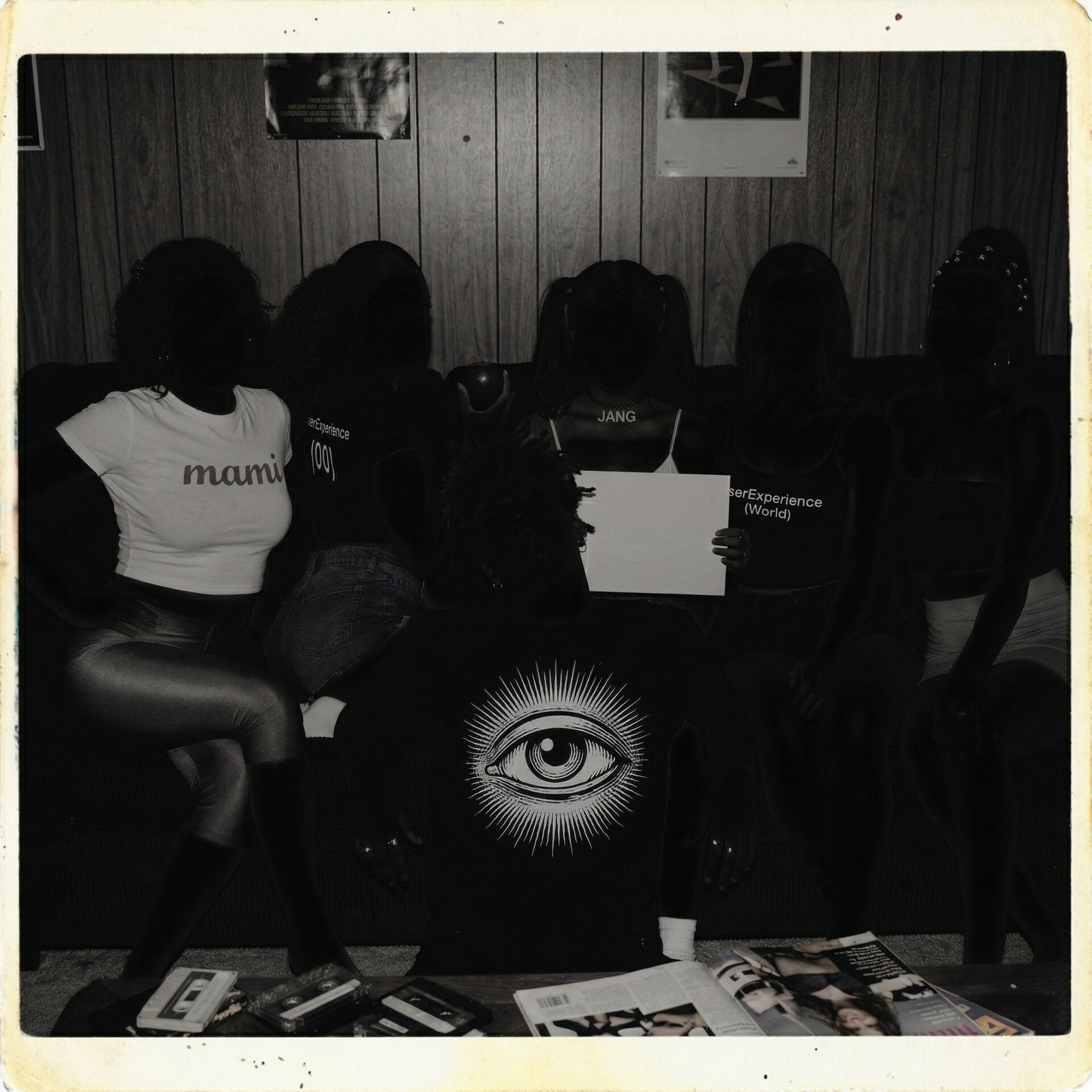
"Ocular Rites"
The photograph arrives like evidence from a room where time has been negotiated. Five women occupy a couch in deliberate arrangement, their bodies angled away from the lens, faces withheld or obscured by shadow and hair. They do not perform for the camera; they endure it. This is the first lesson of the image: presence without presentation, a refusal of the easy transaction between subject and viewer.
The room itself speaks of interim spaces—wood-paneled walls suggesting a basement or a practice space, the kind of venue where ambition outpaces budget. Posters hang crooked above the women's heads, their content illegible but their presence asserting that someone, at some point, cared enough about something to tape it there. The couch is black, absorptive, a void that holds the women's bodies without distinguishing them from its own surface. They wear their own uniforms: one in a white cropped tee bearing the word "mami," another in denim, a third holding a blank white rectangle that could be a sign, a protest, or an erasure. Two wear shirts marked "UserExperience (00)" and "UserExperience (World)"—phrases that read like code, like commentary, like inside jokes that have escaped their original context.
And then, at their feet, the man.
He sits on the floor in the posture of a supplicant or a disciple, his face completely lost in the photograph's deepest shadows. What saves him from disappearing entirely is his shirt: a massive, radiating eye printed across his chest, the iris detailed with concentric circles, the pupil a void surrounded by light. The all-seeing eye, the eye of providence, the eye that watches without blinking. It is theatrical, almost absurd in its symbolism, yet in this room it achieves something stranger than irony. The women do not look at him. He does not look at them. The eye on his shirt looks at nothing and everything simultaneously, a surveillance apparatus that has forgotten its purpose.
The floor around him is littered with the artifacts of making: cassette tapes, their labels handwritten and peeling; magazines opened to faces that echo the women's own turned-away postures. These are the tools of curation and circulation, the physical media that preceded our current moment of infinite, weightless content. Someone here is building something. The debris suggests process rather than conclusion.
What the image captures, finally, is a particular quality of attention that has nothing to do with the eye on the man's shirt. The women are gathered but not grouped, together but not unified. Their body language speaks of familiarity without intimacy, of shared space without shared purpose. The one holding the blank rectangle seems to offer it to no one in particular. The one in "mami" leans forward, her spine a curve of waiting. They are, perhaps, between takes, between songs, between the person they were when they entered this room and whoever they will be when they leave it.
The all-seeing eye, in the end, sees nothing of this. It is a decoration, a costume, a joke that has gone serious through repetition. The real seeing happens in the negative space of the photograph, in what the women withhold, in the refusal to turn and explain themselves. The image asks us to look at people who will not look back, and in that asymmetry, something honest accumulates: the truth that most seeing is not mutual, that being witnessed is not the same as being known, that rooms like this exist in their own time, indifferent to whoever might document them.
The eye on the shirt keeps watching. The women keep not caring. The photograph keeps its secrets.